
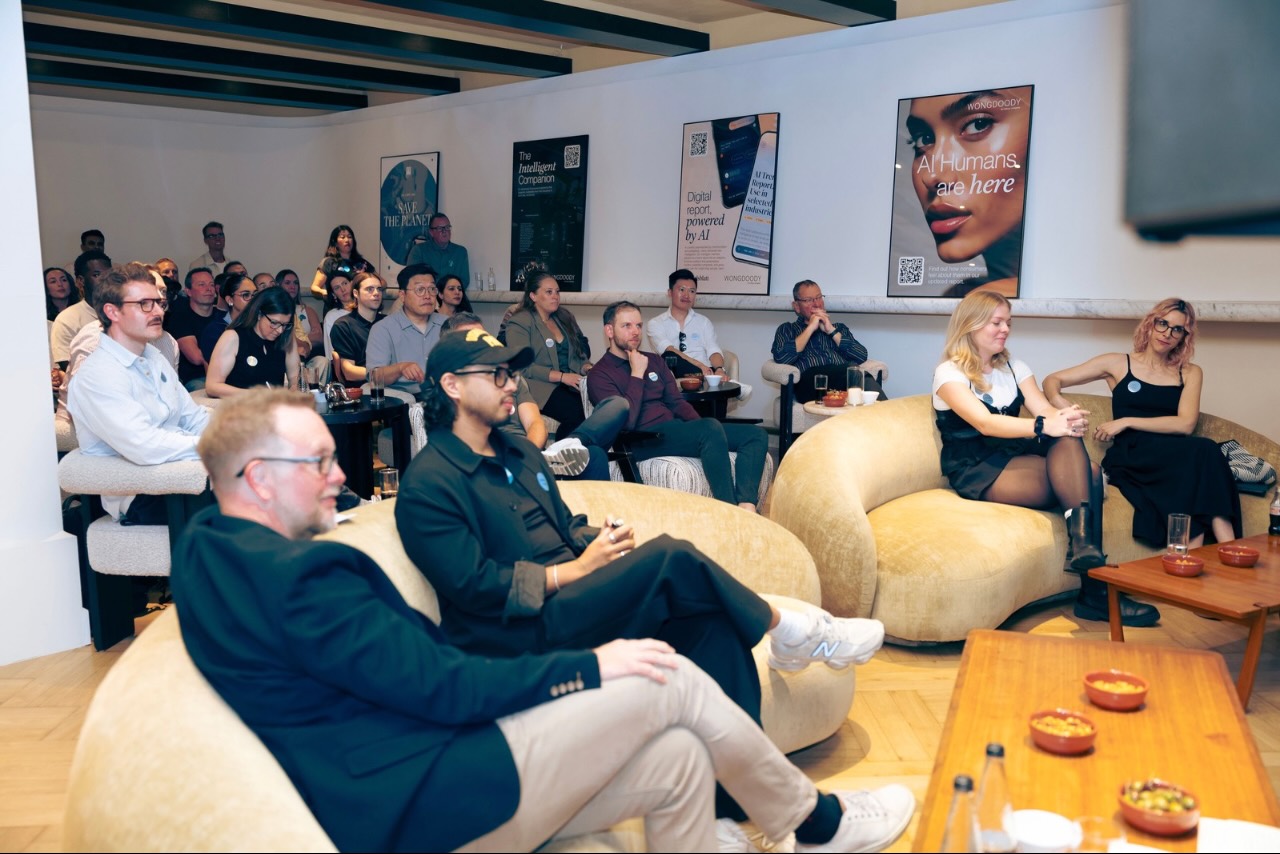
London Event: From Digital Experiences to Agents That Drive Outcomes
This is a headline lorem ipsum.
This is a headline lorem ipsum.
AI is no longer sitting alongside the business as a pilot project - it's becoming the infrastructure the business runs on. At our recent event with IBM, we explored what it actually takes to move beyond AI-powered digital experiences and into AI agents that drive outcomes: resolving issues, booking appointments, and acting on behalf of both the customer and the business.
Through a series of live conversations, a client case study, and a look under the hood of how it's built, six key themes emerged - revealing not just what's possible with agentic AI today, but what it takes to make it real, governed and scalable inside an enterprise.
1. Partnership is about complementary strength, not just technology
Session: The WongDoody x IBM Partnership
Daniel Wittred, Head of Client Growth at WongDoody, and Dan Murphy, Ecosystem Client Manager at IBM, opened by setting the scene: AI adoption across B2B and B2C sales and commerce operations has surged, with adoption scores up as much as 55 points in B2B sales channels alone. What started as experimentation is now core to how buying, service and CRM journeys work.
Each side brings something different to keep pace with that shift. IBM brings the scale and rigour of an enterprise platform: Watsonx comes with governance and auditability built in rather than bolted on, backed by 115 years of enterprise credibility, and modular enough that the first joint activation - with Mitsubishi Motors - reached market in 12 weeks, deployed however a client's existing stack needs it. WongDoody brings the creative practice: turning that technology into something people actually want to use, judged on real business impact, human-centred by design, and adapted to each client's ambition rather than sold as one fixed product.
“AI adoption is a journey and it's complex - but the technology should never be the constraint that stops creativity becoming reality.”
2. The customer journey hasn't kept pace with rising expectations
Session: Navigating Today's Landscape
Maddy Frost, Strategy Director, set out why the complexity of customer journeys has grown faster than the infrastructure built to handle it, creating strain across three areas: experience, intelligence and operations. On experience, 73% of buyers now use AI somewhere in their B2C journey, and 49% of Gen Z shoppers say they're less likely to buy from a brand that feels impersonal - yet 78% of marketing leaders admit they struggle to scale personalisation.
On intelligence, only 16% of companies achieve strong sales and marketing alignment, so 56% of buyers end up repeating themselves to different representatives. And on operations, reps spend around 70% of their time on non-selling admin, while the average lead can wait 28 hours for a first response. The net result, mapped across the funnel from awareness to loyalty, is a familiar shape: high-effort workflows producing a low-impact experience for the buyer.
“As journeys become more complex, organisations are struggling to adapt theprocesses, intelligence and experience that underpin them.”
3. The Intelligent Concierge™ turns a fragmented journey into one continuous relationship
Session: The Intelligent Concierge™
Kim Abbott, VP of Experience Design, introduced The Intelligent Concierge™: an adaptive, agent-led assistant that recognises every buyer, adapts to how they want to buy, and - with consent - acts on their behalf. It works through three capabilities: it adapts, reading behaviour and personalising content in real time; it connects, carrying context across every channel so buyers never have to start over; and it acts, booking appointments, resolving issues and completing back-end workflows inside the same conversation.
The proof point was Mitsubishi Motors Canada, a challenger brand that needed to fix a broken sales journey on a tight budget. What launched as a tool engaging 50% of customers and driving 1 in 10 build-and-price journeys has since been rolled out across the entire vehicle range, now engaging over 60% of site visitors and driving 6 in 10 build-and-price journeys.
The team then brought the model to life through a fictional brand, running four live demos across the customer lifecycle - deliberately picking some of the most common challenges customers and businesses run into, to show how the Concierge helps at each stage. Exploring products showed how it lets users dig into a product and find exactly the detail they need. Lead generation showed how it nudges users down the funnel into informed sales conversations. Proactive support showed it staying ahead of the customer, initiating support and taking action on their behalf. And upselling showed it spotting opportunities and acting to engage customers in future sales - all handled behind the scenes by a team of specialist agents (Content, Booking, Sales, Support and Relationship).
“To the buyer, it's a single, continuous, actionable conversation. Behind it, it's doing all the legwork that legacy systems never could.”
4. Real agentic AI is a loop, not a script
Session: Our Model - From Chatbot to Concierge
John-Michael Velasquez, Head of AI/Dev, traced the evolution from rigid chatbot (a pre-determined decision tree with a single entry point and many dead ends), to elastic companion (trigger recognition across multiple entry points, fewer dead ends), to flexible concierge (goal-driven journeys run by multiple expert agents, with no dead ends).
The mechanics come down to a loop: decide (the model works out how to solve the request), choose (it engages a tool via MCP to look something up or take an action), and check (it tests the result against the goal, looping again if it isn't solved). The key distinction: the model does the thinking, but the agent is the model plus its tools, its memory, its limits and this loop - a better model alone doesn't make something agentic without the tools and the loop around it.
“The agent is not the model. It's the model, plus its tools, its memory, its limits, and the loop that keeps it honest.”
5. Scale comes from governed connections to your existing capabilities
Session: Our Model - How We Build It
The architecture sits in five layers: channels (WhatsApp, web, app, voice) at the top; specialist agents handing off to one another; the reasoning model itself; an MCP tool layer connecting to a client's own systems (CRM, stock and pricing, service booking, Jira); and, running through all of it, IBM's governance backbone - authentication, entitlement, versioning, logging and support. Nothing about this requires a client to change or replace what they already run: their CRM, dealer system, stock feeds and booking platform stay exactly where they are. What changes is that those systems become tools the agents can call, each one declared once with a name, a description and a set of permissions, and used under the client's own audit trail - governance the client controls, not a black box on WongDoody or IBM's side.
The point was made concrete with a simple comparison: the same agent, asked the same question, with one difference. Connected to a booking system, it can say a slot is booked and give a reference number. Without that connection, the best it can offer is "here's how booking works, someone will be in touch." Same model, same reasoning - the ceiling is set entirely by what it's allowed to reach, and by what the client has chosen to grant it access to. That's also why the agent team isn't rebuilt from scratch for each client: every client gets the same core agent, with specialist agents (booking, billing, loyalty, voice and so on) added or connected in depending on the sector and what that client's systems allow - banking, telecoms and retail all run different teams, governed the same way, on the same foundation.
“We stop building integrations, and start declaring tools and granting access.”
6. A working Concierge in 10 weeks, not a multi-year programme
Session: Our Model - How to Launch Your Concierge in 10 Weeks
Getting there follows three steps rather than a long build. First, a workshop to define the business goals and land on three potential use cases. Second, a joint IBM x WongDoody recommendation, technically validated, to select and scope one of them, with an agreed cost. Third, a 10-week MVP sprint that ends with a launch-ready Intelligent Concierge - with WongDoody co-investing up to 50% into the launch product.
Closing Thought
From partnership and platform to mechanics and governance, the conversation has moved on from what AI-powered experiences can look like to what agents can actually be trusted to do. Across every session, one message was clear: closing the value realisation gap means pairing ambition with governance, and giving agents not just a better model, but the tools, memory and permissions to act.
For businesses looking to move forward:
> Start small, connect wide: launch a scoped concierge in weeks, then add capability by granting access - not by rebuilding.
> Start with governance, not an afterthought: bring your audit and permissions requirements into scope from day one, so trust is built in rather than retrofitted.
> Start with one journey, not the whole funnel: pick the segment of one that matters most to you first, then extend the same model to the next.
> Start with your own systems, not a new build: bring your CRM, stock feeds or booking platform as they are - the agent connects to what you already run.
Interested?
Please contact daniel.wittred@wongdoody.com who can walk you through the demo.
Lorem ipsum dolor sit amet, consetetur sadipscing elitr, sed diam nonumy eirmod tempor invidunt ut labore et dolore magna aliquyam erat, sed diam voluptua. At vero eos et accusam et justo duo dolores et ea rebum. Stet clita kasd gubergren, no sea takimata sanctus est Lorem ipsum dolor sit amet.
This is a headline lorem ipsum.
This is a headline lorem ipsum.
Lorem ipsum dolor sit amet, consetetur sadipscing elitr, sed diam nonumy eirmod tempor invidunt ut labore et dolore magna aliquyam erat, sed diam voluptua. At vero eos et accusam et justo duo dolores et ea rebum. Stet clita kasd gubergren, no sea takimata sanctus est Lorem ipsum dolor sit amet.


This is a headline lorem ipsum.
This is a headline lorem ipsum.
Lorem ipsum dolor sit amet, consetetur sadipscing elitr, sed diam nonumy eirmod tempor invidunt ut labore et dolore magna aliquyam erat, sed diam voluptua. At vero eos et accusam et justo duo dolores et ea rebum. Stet clita kasd gubergren, no sea takimata sanctus est Lorem ipsum dolor sit amet.
