

Events
Creativity on Trial: My Forecast for SXSW
This is a headline lorem ipsum.
This is a headline lorem ipsum.
I am honored to once again be selected as a panelist for this year’s SXSW Festival of Innovation. From March 12–18, downtown Austin, Texas turns into a gathering place for creatives, designers, entrepreneurs, rising practitioners, and genuinely curious tech-forward innovators to learn where the industry is heading, and to hear from creative leaders about how they stay at the vanguard of design, creativity, and innovation.
My panel, “Lies My Creative Director Told Me: Myths from the Agency World” will be a discussion about the state of the Creative Professional Services industry—where it’s been, where it’s headed, and how to stay afloat and ahead today, tomorrow, and beyond. The panel will be moderated by Barry Fiske, CXO Americas at Merkle, and joining me will be Fura Johannesdottir, Global CCO at Interbrand, and Valerie Carlson, Global CCO at Critical Mass. It promises to be a lively and wide-ranging discussion about the questions plaguing creative leaders as they navigate the murky waters of the current agency landscape.
I have a funny feeling I will be an outlier on the panel. My career, leading up to the present day leading the Design practice for North America at WongDoody Infosys, has been a continuous evolution mixing design, creativity, technology, business, product, and strategy in equal measure. In preparing for the panel, I found myself inspired by Rachel Kobetz, CDO at PayPal, who penned the highly quotable article, “Things I No Longer Believe About Design Leadership”, on her blog on New Year’s Eve. But since the panel is called “Lies My Creative Director Told Me”, here are four lies I have been told that I no longer believe to be true, which will be fodder for our debate on March 16 in Austin:
Lorem ipsum dolor sit amet, consetetur sadipscing elitr, sed diam nonumy eirmod tempor invidunt ut labore et dolore magna aliquyam erat, sed diam voluptua. At vero eos et accusam et justo duo dolores et ea rebum. Stet clita kasd gubergren, no sea takimata sanctus est Lorem ipsum dolor sit amet.
This is a headline lorem ipsum.
This is a headline lorem ipsum.
Lie #1: “It’s all about awards.”
The very term “Creative” is a loaded one in the Agency world. In its desperate attempts to strike an inclusive tone, it more often than not seeks to define Creative in a very narrow way. I, however, see “Creative” in two related but distinct parts, spun from the same fabric yet still somehow made of different materials:
- Divergent/Interruptive, and
- Convergent/Invisible
It is my strong belief, developed over time, that the best work is the kind that seamlessly blends into the background, only making itself known when required or requested. It remains invisible, and requires the careful orchestration of many different parts to pull off its balancing act, i.e. convergence. Unfortunately for many agencies, the former has been valued over the latter. The work that stops you in your tracks, jumps out and says “look at me!” is, admittedly, awarded in the trades and more highly decorated. But awards can cloud one’s judgment, especially when it becomes the goal of the work instead of the ancillary outcome, thereby losing the plot of the creativity that inspired it.
The Truth: The main goal of “the Work” is to drive business results, plain and simple. And that is true of both the divergent and the convergent work. And that shows up in awards shows as well - the most highly decorated work is both beautiful and performant. But agencies that value the divergent, interruptive work over the convergent, invisible work, quickly find out that it is costly, highly subjective, difficult to operationalize at scale, and extremely labor-intensive, even in the age of AI. Simply put, the value of the divergent work does not comport with its cost, especially when the C-suite is continuously pressured to do more with less.
Lie #2: “It’s all about “the Work.”
Earlier in my career it was almost a badge of honor to have pulled an all-nighter on a pitch. One time, I even slept under a desk at the client’s office (yes, that did happen, and no, I’m not proud of it). The “work until you get it right”, or more to the point, “work until I say you got it right”, culture is quickly becoming an artifact of the past. The work has taken a significantly different shape and form, and the use of human power to churn, churn, churn through ideas is no longer required. Many design patterns have become commoditized, and MCP can detect those patterns to derive new ones. But the constant drumbeat of “AI coming for our jobs” needs a serious remix. Rather than seeing it as the Work being taken out of the hands of the practitioners, we should see it not through the lens of practitioners’ hands, but through the heart and humanity required to guide, direct, and coach the models that will hopefully render the all-nighter obsolete. Designers, in effect, need to stop designing. In the words of Suff Syed, Head of AI Design at Microsoft, they need to stop worrying about the surface and worry more about the substrate.
With that comes the inescapable question: if you are no longer designing…

The Truth: Artificial intelligence is reshaping how creative work is produced, evaluated, and led. For design leaders, the challenge is not simply adopting new tools, but redefining creative practice so teams can harness AI’s scale while preserving human judgment, cultural sensibility, and ethical clarity. Rather than replacing the term, we should both expand it and define it in more concrete terms. Creative work becomes the practice of coordinating human judgment, context, and values with algorithmic generation. In this view:
- Humans frame problems, make curatorial choices, tell stories, and ensure cultural fit.
- AI supplies volume, pattern recognition, and variant exploration.
- Creative leadership ensures the two are integrated responsibly.
Put simply, the Work is not about the execution, but rather the IP of methods, tools, and decision points that create impact. What do we do here? Nothing less than providing the instruction set for Brand Experience. This both reframes and elevates the Work, and its practitioners.
Lie #3. “It’s all about the people.”
This is of course still very true. The creative community is the lifeblood of the work we do, and People Leadership is a solemn obligation—the one I take most seriously and which brings me the most joy. This lie is moreso a lie of omission. It underscores the subtext: “Yes, but how many?” Team size, makeup, skillset diversity, and methodology are taking new shape. Doing more with less—the mandate for Design leaders everywhere—is where the opportunity lies. No longer is corporate success necessarily reflected by increased headcount. Past team structures were defined by pairings—Art & Copy, IA & Visual Design, etc.
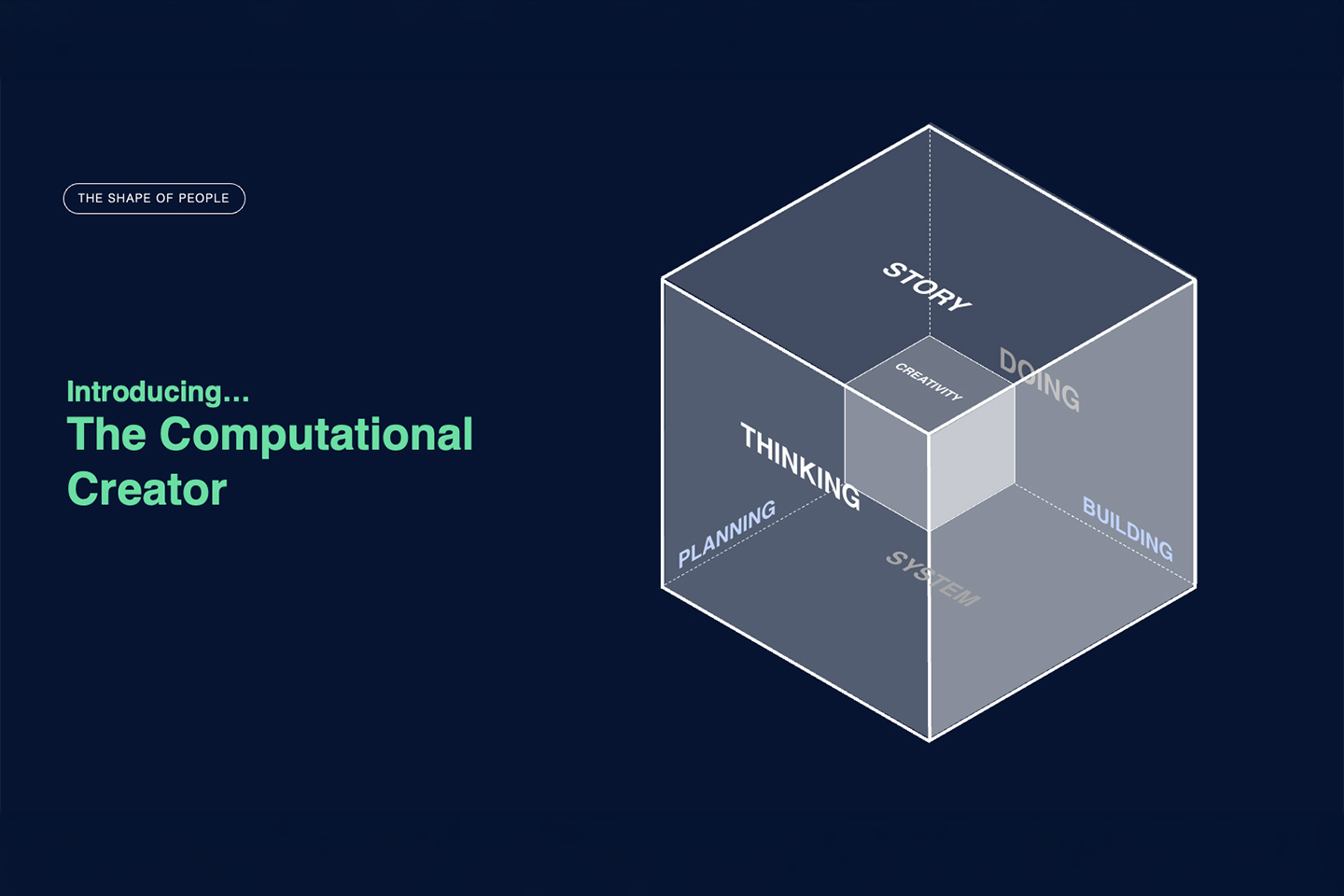
The Truth: Just as the Work has become more convergent, so do the people that create it. I now see smaller but more diversely-skilled, multi-disciplinary teams comprised of what I refer to as “cube-shaped” practitioners. Those that can balance System, Story, Thinking, Doing, Planning, and Building all at once, yet with Creativity still at the core of everything they do. I call these practitioners “Computational Creators”.
Lorem ipsum dolor sit amet, consetetur sadipscing elitr, sed diam nonumy eirmod tempor invidunt ut labore et dolore magna aliquyam erat, sed diam voluptua. At vero eos et accusam et justo duo dolores et ea rebum. Stet clita kasd gubergren, no sea takimata sanctus est Lorem ipsum dolor sit amet.


This is a headline lorem ipsum.
This is a headline lorem ipsum.
This is very complementary to the question about the Work. It changes how we perceive the work, and what it takes to do it. This means…
…Performance metrics should evolve:
- Value impact, novelty, ethical alignment, and user satisfaction, not just volume or speed.
- Include learning impact, collaboration with AI, and contributions to team knowledge in evaluations.
- Reward curiosity and knowledge-sharing as measurable components of performance reviews.
…Design leaders should champion hybrid workflows that make clear what’s AI-assisted and what remains human-led.
- Use AI for ideation volume, trend synthesis, and rapid prototyping.
- Reserve humans for framing problems, selecting direction, storytelling, and final decisions.
- Redefine briefs to call out which tasks are AI-appropriate and how outputs will be evaluated.
…Agencies must embrace cross-functional thinking and new roles.
- Form squads that combine designers, data scientists, content strategists, and ethicists.
- Balance idea-driven creatives with those who can translate AI outputs into production-ready work (editorial, engineering).
- Introduce lightweight governance councils to evaluate new tools and approve safe experimentation quickly.
…Design operations must adopt new practical practices, such as:
- Build rapid prototyping labs where AI generates dozens of concepts and humans curate the best.
- Maintain a living repository of prompts, failure cases, and post-mortems as institutional memory.
- Introduce “creative stewardship” roles responsible for brand voice, cultural sensitivity, and long-term coherence.
…and as tools evolve, skill priorities shift.
- Teach
prompt craftas a core craft: iterative prompt design, chaining prompts, evaluation, and optimized credit usage. - Prioritize storytelling and contextualization: humans add meaning and purpose that models lack.
- Embed ethics and cultural fluency into hiring, training, and reviews to reduce bias and widen resonance.
…which requires us to then put guardrails in place that are lightweight but effective.
- Maintain human-in-the-loop checkpoints at key moments: final concept selection, public launch, and culturally sensitive content.
- Create an AI use playbook: data provenance, acceptable usage, escalation paths for legal or ethics concerns.
- Define brand-voice guardrails for models: exemplar outputs, banned language lists, and tone guides.
- Require accessibility and inclusion checks on AI-generated content.
…all of which leads to Lie #4: “It’s all about the Creative Director”.
This is one I have not believed for quite some time. The role of Creative Director-as-deity has been thoroughly debunked by data-driven design approaches, e.g. the CD is not the arbiter of successful design; Users are. The role of Creative Leader has irrevocably shifted, and I, for one, am here for it.
The Truth: Here are just some of the universal truths I now believe stridently:
- Creative Leaders must model curiosity and normalize experimentation.
- Protect exploratory time: allow designers regular, time-boxed hours for AI experiments without delivery pressure.
- Run show-and-tell and “AI swap meets” where teams demo surprising outputs and translations into work.
- Publicly share failed experiments and what you learned—this normalizes risk-taking and accelerates shared learning.
- Keep a personal creative practice (art, writing, music) to stay inspired and resist routinization.
- Creative Leaders must by lifelong learners
- Do not ask your team to do what you are not willing to do yourself. Run your own experiments using the tools you are foisting on your teams. If I can do it, surely you can too.
- Create micro-learning pathways: short guided modules on new models, tools, and techniques with hands-on labs.
- Rotate leaders through hands-on AI sprints so they participate rather than merely observe.
- Curate internal trend dashboards that synthesize cultural motifs, visual language shifts, and competitor moves—automated by AI, curated by humans.
- Hold monthly leadership trend reviews to translate signals into strategy.
- Creative Leaders must make experimentation safe, visible, and repeatable.
- Keep a searchable repository of successful prompts and failure cases.
- Host public-facing “making” events to build trust and transparency about human–AI collaboration.
- Run scenario planning to explore 3–5 year role changes and strategic risks.
- Pilot experiments that compare human-only, AI-assisted, and hybrid workflows to refine where AI adds value.
- Creative Leaders must expect role expansion and rebalancing, not just for their teams but for themselves:
- New roles: creative stewards, AI creative strategists, AX designers, and governance leads.
- Human creative skills—judgment, narrative, cultural fluency—become premium.
- And finally, Creative Leaders must adopt a Player-Coach-Operator mindset: The trend of managers also being Individual Contributors is a healthy, albeit controversial one. This is not about taking work away from the team, or getting paid the same amount to both lead and do the work. Creative Leaders must be close enough to the work to empathize with practitioners, but also remain at an appropriate elevation to help the business evolve and positively transform itself, which can only be done with a firm grasp of its funding and operating models.
Closing
I believe Design Leaders and Creative Leaders are Business leaders. After all, if you are in the Creative Professional Services space, you ARE the business. AI changes the mechanics of creative work but not its purpose: solving meaningful human problems with clarity, empathy, and cultural insight. Creative leaders who combine curiosity, ethical rigor, and practical governance can help teams harness AI’s scale while keeping human judgment, story, and craft at the center of value creation. The task is not to replace “creative” but to broaden and refine it—so that human creativity guides how machines generate, and human values shape what they produce. And as much it is helpful to know, understand, and create safe spaces around the “new” Work, knowing how the business operates to support and extend it must be foremost in our minds. This is how we ensure Creativity remains at the core of what we do, and even more importantly, how we lead.
Lorem ipsum dolor sit amet, consetetur sadipscing elitr, sed diam nonumy eirmod tempor invidunt ut labore et dolore magna aliquyam erat, sed diam voluptua. At vero eos et accusam et justo duo dolores et ea rebum. Stet clita kasd gubergren, no sea takimata sanctus est Lorem ipsum dolor sit amet.